
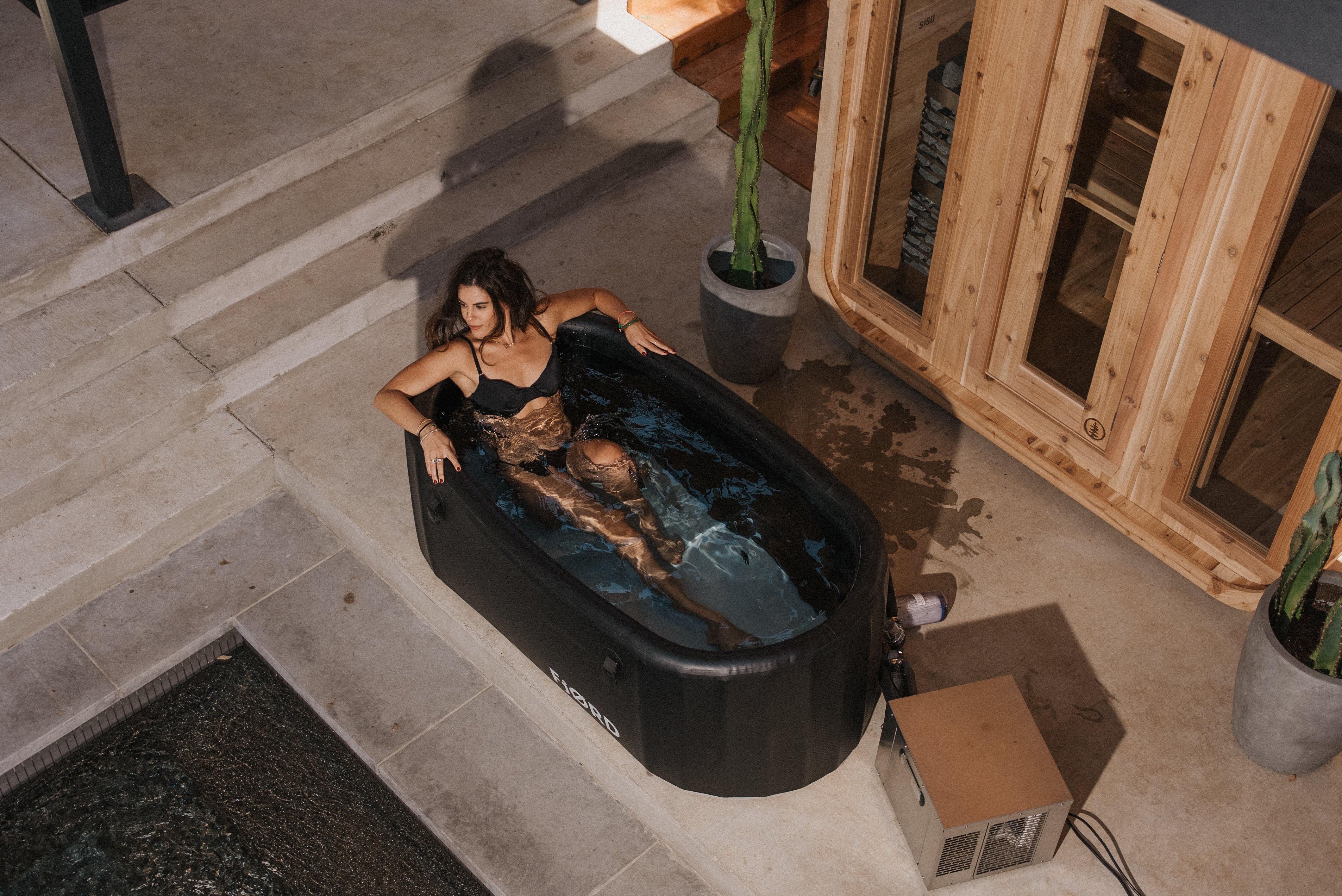
Cold plunge, ice bath, contrast therapy. People use these terms interchangeably, but they describe three meaningfully different approaches to cold water therapy. If you’re researching cold plunge tubs or trying to figure out which recovery method is right for your home, your gym, or your family, the distinctions matter. They affect cost, convenience, hygiene, consistency, and (most importantly) whether you will actually stick with the habit long enough to see results.
Below, we break down each method, the science behind it, and how to choose the one that fits your goals and your season of life.
What Is an Ice Bath?
An ice bath is the simplest entry point into cold water immersion. You fill a bathtub, stock tank, or large container with water and dump in bags of ice until the temperature drops into the therapeutic range, typically somewhere between 50°F and 59°F (10°C to 15°C). Research published in the European Journal of Applied Physiology found that immersion at 14°C (57°F) increased plasma norepinephrine concentrations by 530% and dopamine by 250%, demonstrating the powerful neurochemical response cold water can trigger (Šrámek et al., 2000).
Ice baths are great for experimentation. They cost almost nothing to try, which makes them a low-risk way to discover whether your body responds well to cold exposure. Athletes have used them for decades as a post-training recovery tool, and a systematic review in Frontiers in Physiology confirmed that cold water immersion can meaningfully reduce delayed-onset muscle soreness and support short-term recovery after high-intensity exercise (Machado et al., 2023).
The downsides of ice baths are practical.
Temperature is hard to control. A bag of ice in a Texas summer melts in minutes. In a Canadian winter, the water may be too cold without any ice at all. You have no filtration, no sanitation, and no way to maintain a consistent temperature from session to session. Hygiene becomes an issue fast, especially if multiple people are using the same water. And the setup and teardown time creates friction that kills the habit before it starts.
For a one-off experiment or an occasional post-game plunge, ice baths work. For a daily practice, they are the least sustainable option.
What Is a Cold Plunge?
A cold plunge is a dedicated, purpose-built system designed for repeated daily use. Unlike an ice bath, a cold plunge tub includes a chiller that maintains a precise water temperature (often as low as 36°F to 39°F) along with a pump and filtration system that keeps the water clean session after session. Products like the FjØRD Lux are engineered with American-made chillers, ozone-ready sanitation, and insulated shells so the water is cold, clean, and ready every time you step in.
The difference between a cold plunge and an ice bath is the difference between a gym membership and doing push-ups in your living room once a month. Both involve exercise, but only one builds a sustainable routine. Research suggests that the benefits of cold water immersion, including improved mood, reduced muscle soreness, and better sleep, are dose-dependent, meaning they compound with consistent, repeated exposure over weeks and months (PLOS ONE, Esperland et al., 2025). A cold plunge removes every barrier to consistency: no ice runs, no draining, no guessing the temperature.
Cold plunges are also better for families and commercial settings. Because the water is filtered and sanitized, multiple users can share the same tub safely. Whether you are a wellness center adding a recovery modality for clients or a family that wants to build a morning ritual together, a dedicated plunge system is built for shared, daily use.
If you are evaluating which cold plunge is right for your space, the FjØRD Cold Plunge Buyer’s Guide walks you through the 11 essential questions to ask before you buy, covering climate, placement, chiller capacity, and maintenance.
What Is Contrast Therapy?
Contrast therapy is the practice of alternating between heat exposure and cold exposure, typically a sauna or hot tub followed by a cold plunge, then back again for multiple rounds. The protocol has roots in Finnish and Scandinavian bathing traditions that go back centuries, and the modern science behind it is compelling.
A landmark study published in JAMA Internal Medicine followed 2,315 Finnish men for over 20 years and found that frequent sauna use was associated with a significantly lower risk of sudden cardiac death, fatal cardiovascular disease, and all-cause mortality. Men who used a sauna four to seven times per week had a 40% lower risk of all-cause mortality compared to those who used it once per week (Laukkanen et al., 2015).
When you layer cold water immersion on top of heat exposure, the physiological effects intensify. The rapid alternation between vasodilation (from heat) and vasoconstriction (from cold) creates what researchers describe as a “vascular pump” effect that enhances circulation, accelerates lactate clearance, and improves cardiac autonomic regulation (PMC, Esperland et al., 2025). Contrast therapy has also been shown to reduce cortisol levels and boost norepinephrine, a neurotransmitter linked to alertness, mood, and focus (Shevchuk, 2008).
For people chasing better recovery, deeper sleep, and a stronger mental reset, contrast therapy (sauna plus cold plunge) is extremely hard to beat. You can learn more about how cold exposure affects mood, testosterone, and blood pressure in our deep dive on the impact of cold plunging on testosterone, fat burning, and blood pressure.
Cold Plunge vs Ice Bath vs Contrast Therapy: Key Differences at a Glance
Understanding the practical differences helps you make the right investment for your goals.
Temperature control. An ice bath gives you a rough estimate at best. A cold plunge system like the FjØRD Lux holds a precise temperature (down to 36°F) day after day. Contrast therapy adds heat as a variable, so temperature control on both ends matters.
Hygiene and water quality. Ice baths have no filtration. You drain and refill every session, or you sit in increasingly questionable water. Cold plunge tubs include multi-stage filtration and optional ozone sanitation. This is critical if the tub is shared by a household, a gym, or a wellness clinic.
Habit sustainability. The single biggest predictor of results from cold water therapy is whether you keep doing it. A system that is always cold, always clean, and always ready eliminates the friction that stops most people. If you are interested in designing your own cold plunge protocol, having reliable equipment is the foundation.
Cost. An ice bath costs almost nothing upfront but adds up in ice, water bills, and time. A cold plunge is a higher initial investment. Products like the FjØRD Sport offer a portable, drop-stitch option for athletes and travelers, but operating costs are minimal (as low as $13 to $17 per month in electricity). Contrast therapy requires both a heat source and a cold plunge, making it the largest investment but also the most comprehensive recovery protocol.
Recovery depth. Ice baths and cold plunges deliver similar cold water immersion benefits. Contrast therapy adds the cardiovascular, relaxation, and hormonal benefits of heat exposure on top. For the deepest recovery, mood enhancement, and sleep improvement, the combination is supported by the strongest body of evidence.
So Which Is “Best”? It Depends on Your Goal
There is no single best answer. The right choice depends on where you are in your cold water therapy journey and what you are optimizing for.
If you are experimenting, start with an ice bath. Fill your bathtub with cold water and ice and see how your body responds. It is the cheapest way to test whether cold exposure works for you before committing to dedicated equipment.
If you want a daily practice, invest in a cold plunge. A purpose-built system like the FjØRD Lux or the FjØRD Sport removes every barrier between you and a consistent cold immersion habit. The water is always at the right temperature, always filtered, and always ready. That reliability is what turns a one-off experiment into a daily ritual.
If your focus is recovery, mood, and sleep, pair a sauna with a cold plunge for contrast therapy. The combination of heat and cold delivers benefits that neither modality achieves alone, from improved cardiovascular markers to elevated dopamine and norepinephrine to deeper, more restorative sleep. The FjØRD bundle builder lets you combine products to create the exact setup you need.
What FjØRD Builds Is the Backbone of a Daily Ritual
FjØRD Cold Plunge was founded on a simple idea: cold water therapy should be accessible, reliable, and beautiful enough that you actually want to use it every day. Every FjØRD tub is American-made with a high-performance chiller, integrated filtration, and a Scandinavian-inspired design that fits into your home, your backyard, or your wellness business.
We do not just sell a tub. We build the infrastructure for a daily practice, one that supports better recovery, sharper focus, and a calmer mind. Whether you start with a single plunge or build a full contrast therapy station with sauna and plunge, the goal is the same: pick the tool that supports the ritual you actually want to live.
Explore the full FjØRD Cold Plunge lineup →
References
Šrámek, P., Simečková, M., Janský, L., Šavlíková, J., & Výbíral, S. (2000). Human physiological responses to immersion into water of different temperatures. European Journal of Applied Physiology, 81(5), 436–442. https://pubmed.ncbi.nlm.nih.gov/10751106/
Laukkanen, T., Khan, H., Zaccardi, F., & Laukkanen, J. A. (2015). Association between sauna bathing and fatal cardiovascular and all-cause mortality events. JAMA Internal Medicine, 175(4), 542–548. https://pubmed.ncbi.nlm.nih.gov/25705824/
Shevchuk, N. A. (2008). Adapted cold shower as a potential treatment for depression. Medical Hypotheses, 70(5), 995–1001. https://pubmed.ncbi.nlm.nih.gov/17993252/
Machado, A. F., et al. (2023). Effects of cold water immersion after exercise on fatigue recovery and exercise performance (meta-analysis). Frontiers in Physiology, 14, 1006512. https://fjordcoldplunge.com/blogs/news/cold-water-immersion-for-athletic-recovery-a-review-of-recent-evidence
Esperland, D., et al. (2025). Effects of cold-water immersion on health and wellbeing: A systematic review and meta-analysis. PLOS ONE. https://journals.plos.org/plosone/article?id=10.1371/journal.pone.0317615
Knechtle, B., et al. (2025). The untapped potential of cold water therapy as part of a lifestyle intervention for promoting healthy aging. PMC. https://pmc.ncbi.nlm.nih.gov/articles/PMC11872954/
What's the Best Way to Integrate Cold Exposure into a Daily Routine?
Cold Water Immersion for Mental Health and Stress Resilience