
The most powerful cold plunge stories I hear are not about six packs. They are about people who were anxious, stuck, overwhelmed, and found a way to regain control. Not through a supplement or a hack, but through a daily practice of choosing discomfort on purpose, breathing through it, and walking away stronger.
Cold water immersion is gaining serious attention in the mental health space, and for good reason. The emerging science supports what thousands of cold plunge practitioners already know from experience: deliberate cold exposure can be a potent tool for managing anxiety, building stress resilience, and improving mood when used as part of a broader wellness routine.
What Happens in Your Brain and Body During a Cold Plunge
When you step into cold water (typically between 38°F and 59°F), your body triggers a cascade of neurochemical and physiological responses. This is not a gentle nudge. It is a full-system activation.
Research published in the European Journal of Applied Physiology found that immersion in 14°C (57°F) water increased plasma norepinephrine by 530% and dopamine by 250% (Šrámek et al., 2000). These are not marginal shifts. Norepinephrine plays a central role in attention, arousal, and mood regulation. Dopamine is the neurotransmitter behind motivation, reward, and the ability to feel pleasure. Deficits in both are closely associated with depression, anxiety, and emotional dysregulation.
A 2023 fMRI study demonstrated that even a single bout of cold water immersion increased connectivity between large-scale brain networks involved in emotional regulation, including the prefrontal cortex, anterior insula, and anterior cingulate cortex (Yankouskaya et al., 2023). The same study found that participants’ ratio of positive to negative affect shifted from 1.75 before immersion to 3.00 after, a threshold researchers associate with flourishing mental wellbeing.
A review in The Journal of Neuropsychiatry and Clinical Neurosciences further confirmed that cold water immersion triggers the release of dopamine, serotonin, cortisol, norepinephrine, and beta-endorphins, all of which modulate neural responses to stress and emotion-related circuits affected in depression, anxiety, and PTSD (Journal of Neuropsychiatry, 2024).
Why Cold Plunging Is So Effective for Mental Health
The physical mechanism is important, but it does not explain the full picture. The reason cold water immersion works so well for mental health is that it operates on multiple levels at once: neurochemical, psychological, and behavioral.
It gives you a safe, time-bound stressor you can choose. Anxiety often stems from a feeling of being out of control, overwhelmed by stressors that are unpredictable and unrelenting. A cold plunge flips this dynamic. You choose the stressor. You set the temperature. You decide when to get in and when to get out. This concept of voluntary hormetic stress, where a moderate, controlled stressor improves your capacity to handle future stress, is well established in the research literature (Kopplin & Rosenthal, 2022).
It forces you to practice doing the opposite of what your body wants. When you enter cold water, every instinct says: get out, gasp, panic. Staying in the plunge and breathing slowly through the discomfort is a real-time rehearsal for staying calm under pressure. Over time, this practice strengthens the parasympathetic nervous system and builds what researchers call cross-stressor adaptation, the ability to remain composed in the face of challenges that have nothing to do with cold water. If you want to learn how to design your own cold plunge protocol for this kind of stress training, we have a full guide on the blog.
It gives you a clear win early in the day. There is a compounding psychological effect to completing something hard before breakfast. When you plunge at 48°F for three minutes and walk out the other side, you have already done the hardest thing you will do all day. That reframes the rest of your morning and, over time, reshapes how you see yourself. This is not just physiology. It is identity.
What the Research Says About Cold Exposure and Mood
The first comprehensive systematic review and meta-analysis on CWI and general health outcomes was published in PLOS ONE in January 2025. Across 11 randomized controlled trials and 3,177 participants, the review found that cold water immersion was associated with improvements in mood, reductions in stress, and enhanced mental wellbeing (Cain et al., 2025). The authors noted that the effects of CWI appeared to be time-dependent, with delayed reductions in stress observed 12 hours post-immersion, suggesting that the practice may serve as a valuable component of a broader stress management strategy.
Earlier, Shevchuk (2008) proposed that adapted cold showers could serve as a potential treatment for depression based on the activation of the sympathetic nervous system and the resulting surge in norepinephrine and beta-endorphins (Shevchuk, 2008). While this remains a hypothesis rather than a clinical protocol, the neurochemical pathway it describes has since been supported by multiple studies.
A randomized trial published in Current Psychology found that combining cold exposure with structured breathing techniques produced moderate to strong reductions in perceived stress among healthy adults, outperforming a control group (Kopplin & Rosenthal, 2022). And a 2025 semi-randomized controlled trial of 404 participants found that a protocol combining breathwork and cold immersion led to greater improvements in self-reported energy, mental clarity, and ability to handle stress compared to a meditation-only control group (Scientific Reports, 2025).
Cold water immersion has also been shown to activate the immune system and reduce inflammatory markers, which are increasingly linked to depression and anxiety. Six weeks of repeated cold immersion increased T lymphocytes and other immune markers in athletic young men, and habitual winter swimmers showed significantly higher concentrations of immune-related biomarkers compared to controls (PMC, Knechtle et al., 2025).
What This Looks Like in Practice
When someone messages me and says, “I went from panic attacks and scattered days to starting my morning with three minutes in 48°F and journaling afterward,” that is not an anecdote I take lightly. That is a person who found a tool that helps them anchor their day, regulate their nervous system, and show up differently in their life.
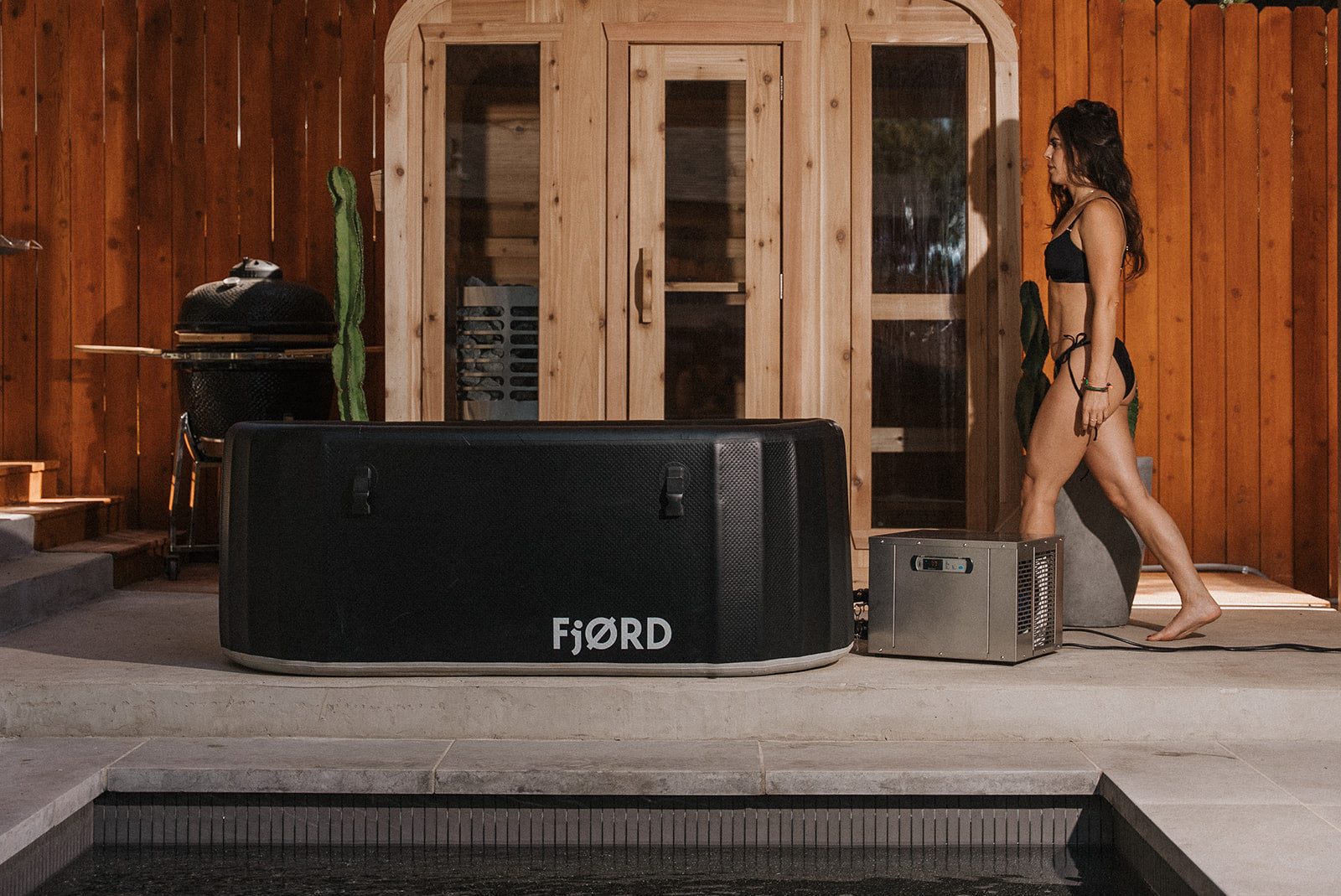
The ritual usually looks something like this: wake up, step into the FjØRD Lux or FjØRD Sport at a set temperature, breathe through the first 30 seconds of discomfort, settle into stillness for two to five minutes, step out, and start the day with a calm clarity that was not there before. Some people pair it with journaling. Some pair it with sauna for contrast therapy. Some just stand in the kitchen afterward and drink their coffee in silence, because for the first time in a long time, they do not feel the need to immediately reach for their phone.
The key is that the plunge is always cold, always clean, and always ready. That is why a dedicated system matters. If you have to buy ice, fill a tub, wait 30 minutes, and clean up afterward, the friction kills the habit before it has a chance to change anything. A FjØRD cold plunge is built to eliminate that friction entirely: precise temperature control down to 36°F, integrated filtration and sanitation, and a design that looks good enough to live in your home or your backyard year-round.
An Important Note About Cold Plunging and Mental Health
Cold plunging will not replace therapy, medication, or professional support if you need it. If you are managing a diagnosed condition, talk to your healthcare provider before starting any new practice. Cold exposure is a stressor, and it is not appropriate for everyone, particularly those with cardiovascular conditions or unmanaged blood pressure.
But as part of a broader system (alongside sleep, movement, nutrition, professional care, and community), deliberate cold exposure can be an incredibly potent lever for mood, focus, and resilience. The research is growing. The anecdotal evidence is overwhelming. And the mechanism of action, through dopamine, norepinephrine, beta-endorphins, and nervous system training, is grounded in serious science.
For a deeper look at the physiological benefits, including how cold exposure affects athletic recovery, testosterone and fat burning, and overall wellness, explore the FjØRD blog.
Build the Ritual That Changes How You Start Your Day
What we build at FjØRD is not just a tub. It is the backbone of a daily ritual that supports your mental health, your focus, and your resilience. Whether you start with the portable FjØRD Sport or the premium FjØRD Lux, the goal is the same: give you a tool that is always ready so you can build a practice that actually sticks.
If cold plunging has helped your mental health, I would genuinely love to hear your story. And if you are just starting to explore it, know that the hardest part is stepping in the first time. Everything after that gets easier.
Explore the full FjØRD Cold Plunge lineup →
References
Šrámek, P., Simečková, M., Janský, L., Šavlíková, J., & Výbíral, S. (2000). Human physiological responses to immersion into water of different temperatures. European Journal of Applied Physiology, 81(5), 436–442. PubMed
Yankouskaya, A., et al. (2023). Short-term head-out whole-body cold-water immersion facilitates positive affect and increases interaction between large-scale brain networks. Biology, 12(2), 211. PMC
Journal of Neuropsychiatry and Clinical Neurosciences (2024). Cold-water immersion: Neurohormesis and possible implications for clinical neurosciences. Full Article
Shevchuk, N. A. (2008). Adapted cold shower as a potential treatment for depression. Medical Hypotheses, 70(5), 995–1001. PubMed
Kopplin, C. S., & Rosenthal, L. (2022). The positive effects of combined breathing techniques and cold exposure on perceived stress: A randomised trial. Current Psychology, 42, 27058–27070. Springer
Scientific Reports (2025). A semi-randomised control trial assessing psychophysiological effects of breathwork and cold immersion. Nature. Full Article
Cain, T., et al. (2025). Effects of cold-water immersion on health and wellbeing: A systematic review and meta-analysis. PLOS ONE. Full Article
Knechtle, B., et al. (2025). The untapped potential of cold water therapy as part of a lifestyle intervention for promoting healthy aging. PMC. Full Article


Cold Plunge vs Ice Bath vs Contrast Therapy: What Is the Difference?
Cold Plunge Myths vs Facts: What the Science Actually Says